

An autonomous space is a Confluence space that maintains its own content lifecycle through three capabilities: autonomous page statuses, automatic page owner notifications, and automatic archiving. It keeps content current, owned, and pruned without anyone running a manual cleanup.
The reason this matters now is AI. Tools like Atlassian Rovo and Atlassian Intelligence read your Confluence to answer questions, and they cannot tell a current page from an abandoned one. If your knowledge base is full of pages nobody has owned since 2018, that is exactly what your AI will quote back to your team.
This article explains what an autonomous space is, why AI raises the stakes for content quality, and why native Confluence cannot maintain itself. It then shows how to build an autonomous space today with Better Content Archiving and Analytics for Confluence.
Why AI can break Confluence without content lifecycle management
Before AI, stale Confluence content was a productivity problem. People wasted time searching, occasionally trusted an outdated page, and complained that search was useless. The cost was real, but smaller in scale than it is today.
Feed AI a stale knowledge base and it does not just fail to help, it launders old information into confident, wrong answers that people trust more than they ever trusted the page.
AI changes the user experience and amplifies the problem in two ways.
-
AI always wants to help, reads everything, and answers with confidence.
When a colleague asks Rovo a question, it does not know that the policy page was superseded two reorganizations ago. It retrieves the most relevant looking page and presents the answer as fact. Stale content gives stale answers, and now those answers arrive instantly, in the flow of work, with no human filter in between. -
AI accelerates the rate at which content goes stale.
On top of retrieving information, AI writing assistants, like Rovo in Confluence, make it faster than ever to create new pages, draft new documentation, and spin up new spaces. Every one of those pages needs an owner, a review cycle, and eventually an archiving decision.
Content creation has been automated, while content lifecycle management has not.
AI is widening the gap between how fast pages are created and how fast they are maintained.
The conclusion is straightforward. Clean, current, owned content is the prerequisite for trustworthy AI in Confluence. You need Confluence content lifecycle management before you use AI for content creation or search.
What is an autonomous Confluence space?
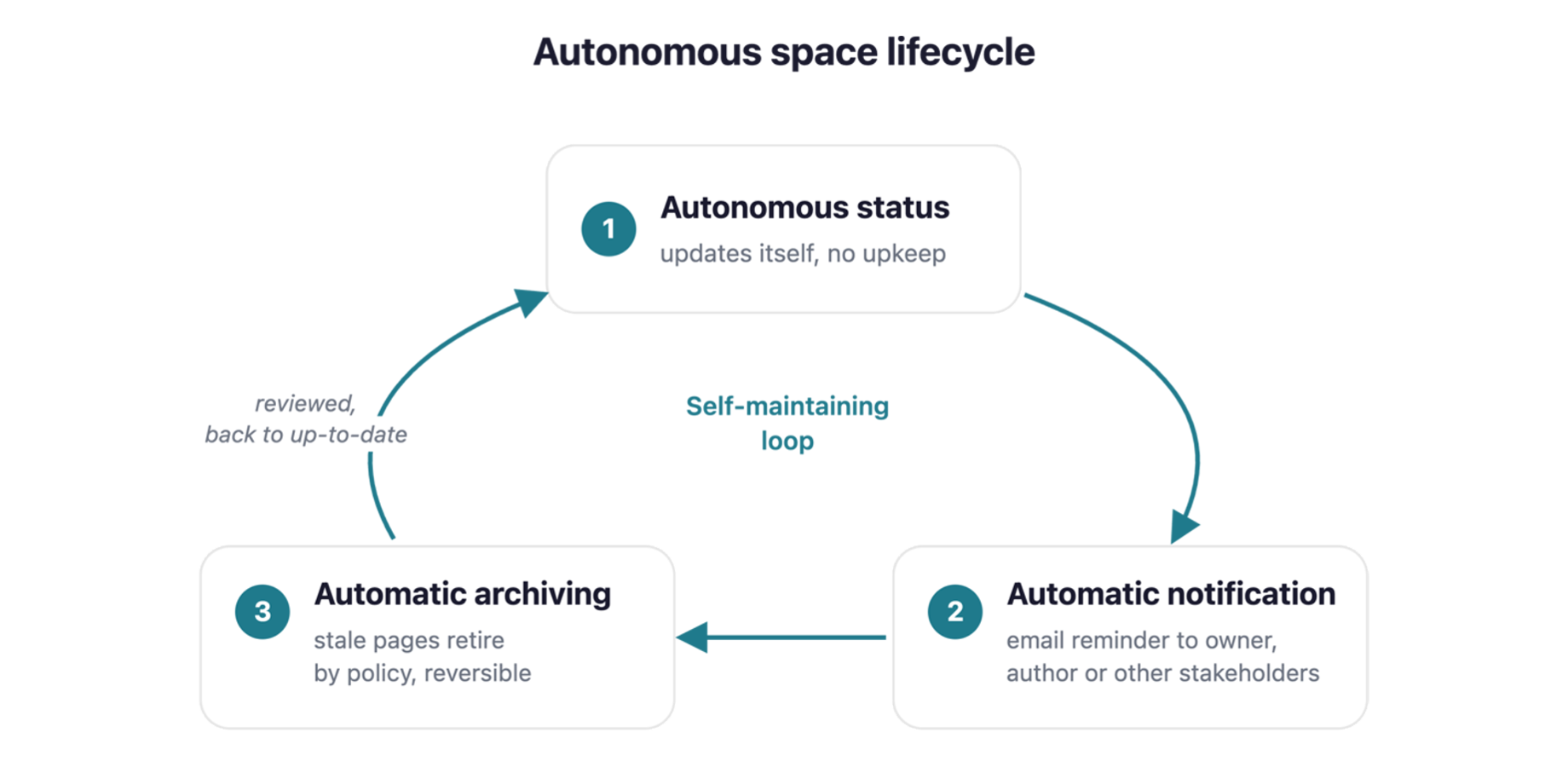
An autonomous space removes the manual labor from content lifecycle management by automating three things that teams otherwise try to do by hand and never finish.
Autonomous page statuses
An autonomous page status is a Confluence page status that updates itself based on rules, current, needs review, outdated, or archived, without anyone setting it manually.
A status change should not depend on a person remembering to change it manually. Rules tie the status to real signals: how long since the last update, how long since anyone viewed the page, whether a review cycle has elapsed or anything else your document workflow dictates.
This is what gives both readers and AI a reliable signal about which pages to trust. For the mechanics of automatic statuses, see the deep dive on Confluence page status and reporting.
Automatic page owner notifications
An automatic page owner notification is an email sent to the responsible owner when their page needs review, without anyone scheduling or remembering it. Accountability is the part of content governance that quietly fails first. A page gets an owner, but then that person changes teams, and the page becomes an orphan that no one feels responsible for.
Automatic notifications close that gap by routing review reminders to the current owner or other stakeholders on a schedule, so content stays accountable as the organization changes around it. See Confluence notification and reminder to page owners for how the notification types and recipients work.
Automatic archiving in autonomous spaces
Automatic archiving is the rule-based removal of stale pages from active view, archived safely so they stay searchable and reversible, without manual cleanup. The reason Confluence fills up with outdated content is not laziness. It is that nobody wants to be the person who deletes the wrong thing.
Automated archiving that runs on mutually agreed rules removes that fear and centralizes governance in one place. Pages are demoted rather than deleted, they remain findable if needed, and the archiving is reversible and transparent.
That makes pruning something a policy can do continuously, instead of something a team attempts once a year and abandons halfway through. See how to archive a Confluence page for the underlying mechanics.
Why native Confluence cannot maintain itself
The Automation for Confluence templates do not add up to an end-to-end solution. As a result, Confluence has no native content lifecycle automation, only isolated pieces that each cover a single use case.
Native page status in Confluence Cloud is a manual label. There is no built-in way to update it from age or usage signals. Native ownership is an author field, not a lifecycle role with routed review notifications. Native archiving is a manual, page-by-page action, sometimes enhanced with unreliable, limited-capacity automation rules.
The result is that maintaining a large Confluence instance natively means assigning humans to do repetitive work that never ends, or to keep debugging failed automation actions. At a few hundred pages it is painful. At thousands of pages across dozens of spaces it is impossible, which is why those instances become content graveyards.
| Lifecycle capability | Native Confluence | Autonomous space with Better Content Archiving and Analytics |
|---|---|---|
| Page status | Manual label, set by hand | Updates automatically from age and usage rules |
| Owner accountability | Author field, no lifecycle notifications | Owner-routed review notifications, sent automatically |
| Archiving | Manual, one page at a time or bulk. Automation exists for simple use cases, unfit for enterprise scale | Policy-based, bulk, scheduled |
| Retention rules | No dedicated capability | Configurable per space |
| Audit trail | No consolidated source of lifecycle actions | Full history, audit-ready |
| Scale | Breaks beyond a few hundred pages | Runs across hundreds of spaces |
A rule engine enforces what AI detects
AI can scan thousands of pages, weigh age, views, and edit history, and surface the ones that look stale faster than any person could. That is real value, and it gets better over time.
Acting on retention rules is a different kind of task, and it is the wrong job for a language model. Whether a document must be kept for six years or deleted within thirty days is not a judgment call. It is a rule set by GDPR, HIPAA, ISO 15489, or SOX, and it has to run the same way on every page, every time.
You do not want a probabilistic model forming an opinion about your retention policy. You want a deterministic system that executes the rule exactly as written, never improvises, and records what it did.
Here is how the two layers divide the work:
| AI detection | Deterministic enforcement | |
|---|---|---|
| Finds stale or risky content | Yes, from age and usage signals | Yes, from rules and analytics |
| Applies a fixed retention schedule | Not its job | Yes, for example archive after 24 months |
| Runs GDPR, HIPAA, ISO 15489 rules identically every time | Not by design | Yes, by design |
| Routes review to the owner with an audit trail | No | Yes |
| Produces compliance evidence | No | Yes |
| Behavior | Probabilistic, results can vary | Deterministic, same result every run |
The two work together. AI detection points at what needs attention. A deterministic rule engine decides what happens, applies your retention schedule, routes the review to the owner, and keeps the audit trail. An autonomous space has that enforcement layer on top of AI insights.
How to build an autonomous space with Better Content Archiving and Analytics
Better Content Archiving and Analytics for Confluence is the app that implements the three capabilities that make a space autonomous. It works on Confluence Cloud and Confluence Data Center. Think of it as the deterministic guardrail for your AI-enhanced Confluence.
You build an autonomous space in three steps that map directly to the three capabilities:
- Set up autonomous statuses. Define rules that update each page's status from its age, last update, and view activity, so the lifecycle stage is always accurate without manual upkeep.
- Route notifications to owners. Assign page owners and configure automatic review reminders, so accountability survives reorganizations and team changes.
- Enforce archiving by policy. Define retention rules per space or label, for example archive after a set period of inactivity, with safe archiving that keeps pages searchable and reversible and records the action for audit.
Layered on top is the analytics that shows you what AI will find before you turn it on: which pages are stale, which have no owner, and which spaces carry the most risk. For the full analytics picture, see the guide to Confluence dashboards for all users (yes, free tier included).
Teams already running autonomous spaces
This is not theoretical. nCino moved off Confluence native automation to Better Content Archiving and Analytics to get lifecycle management that holds up at scale. Storck, the maker of merci and Werther's Original, reorganized Confluence Cloud around automatic notifications, page owners, and archiving across more than 4,000 users.
Both did the work that AI rewards: they made their content current, owned, and trustworthy.
The question every Confluence admin will be asked over the next few years is some version of "is our Confluence knowledge base ready for AI?" An autonomous space is how you answer yes.
Make your page statuses automatic, support page owners with reminders, and let policy do the archiving, so when Rovo reads your Confluence, it finds the best information to quote.
